






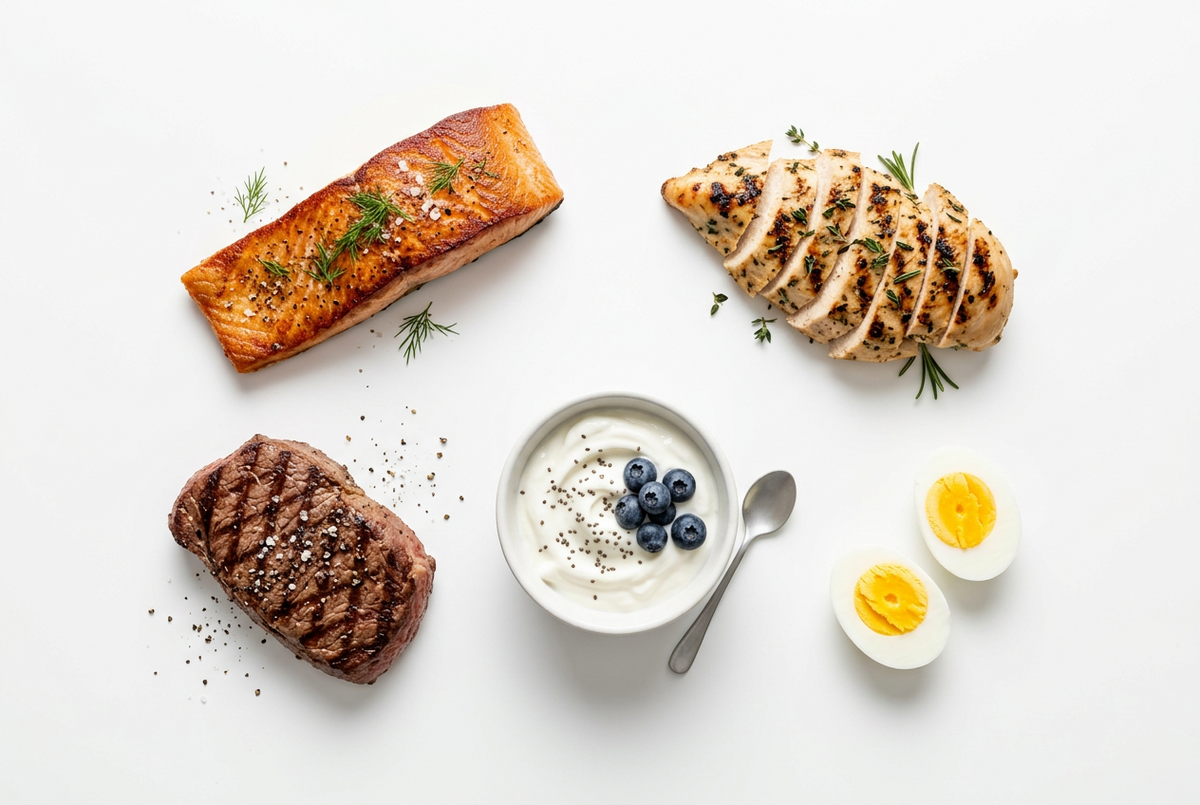
Food Sources of Creatine and Protein: What to Eat and When to Supplement
Quick answer: food can cover your protein needs comfortably, but it struggles with creatine. Herring, beef, pork and salmon are the richest creatine sources, yet you'd need around 700g of raw beef a day to reach the 3g shown to improve performance. Plants contain almost none.
Protein and creatine both support training, but they behave very differently on a plate. Protein is everywhere, from chicken to lentils. Creatine is found almost only in meat and fish, in small amounts, and cooking reduces it further. Here's what to eat for each, how much you'd need, and where a supplement makes sense.
Creatine in food
Herring is the richest food source of creatine, followed by pork, beef and salmon. Figures are for raw weight; cooking can cut creatine by up to around 30%.
|
Food (raw) |
Creatine per 100g |
Raw amount for 3g creatine |
|---|---|---|
|
Herring |
0.65 to 1.0g |
300 to 460g |
|
Pork |
0.5g |
600g |
|
Beef |
0.45g |
670g |
|
Salmon |
0.45g |
670g |
|
Tuna |
0.4g |
750g |
|
Chicken |
0.34g |
880g |
|
Cod |
0.3g |
1kg |
|
Fruit, vegetables, grains, pulses |
Trace or none |
Not achievable |
Your body makes about 1 to 2g of creatine a day, and a mixed diet adds roughly another 1 to 2g. That keeps stores ticking over but doesn't fill them. The authorised health claim is that creatine increases physical performance in successive bursts of short-term, high-intensity exercise, with the benefit seen at a daily intake of 3g. Getting that from food every day means a lot of meat or fish.
Vegetarians and vegans get almost no creatine from diet, so they typically start with lower muscle stores. That also means they tend to see a bigger response when they supplement.
Protein in food
Lean meat and fish give the most protein per 100g, but dairy, eggs, soya and pulses all count. Figures are approximate and vary by product and cooking method.
|
Food |
Protein per 100g (approx.) |
Typical portion |
Protein per portion (approx.) |
|---|---|---|---|
|
Chicken breast, cooked |
31g |
150g |
46g |
|
Lean beef mince, cooked |
26g |
125g |
33g |
|
Tuna, canned in water |
25g |
110g drained can |
28g |
|
Salmon, cooked |
24g |
130g fillet |
31g |
|
Tempeh |
19g |
100g |
19g |
|
Eggs |
13g |
2 large eggs |
13g |
|
Firm tofu |
13g |
100g |
13g |
|
Quark |
12g |
150g |
18g |
|
Cottage cheese |
11g |
150g |
17g |
|
Greek yoghurt, 0% fat |
10g |
170g |
17g |
|
Lentils, cooked |
9g |
150g |
14g |
|
Chickpeas, cooked |
7g |
150g |
11g |
|
Milk |
3.5g |
300ml glass |
10g |
Quality matters as well as quantity. Animal proteins, dairy and soya are complete, with all nine essential amino acids and plenty of leucine, the amino acid that switches on muscle repair. Most pulses and grains are lower in one or more amino acids, so mix sources across the day: beans with rice, hummus with wholemeal pitta, lentils with yoghurt.
Aim for 25 to 40g of protein at each main meal. For people training regularly, 1.6 to 2.2g per kg of bodyweight a day is the range the research supports.
Can you get enough from food alone?
Protein: usually yes. Most people can hit their target with three or four protein-rich meals. A shake earns its place when life gets in the way: after training, on busy days, or when appetite is low. One 30g scoop of Whey Better gives 27.2g of protein, about the same as 90g of cooked chicken breast, with trace fat and carbs.
Creatine: realistically, no. Reaching 3g a day from food means eating around 670g of raw beef or salmon, or 880g of raw chicken, every day, before cooking losses. That's a lot of food, cost and saturated fat for one nutrient. A 3.4g scoop of creatine monohydrate supplies 3g of creatine, costs pennies a day and has no taste worth mentioning.
|
Goal |
Food route |
Supplement route |
|---|---|---|
|
3g creatine a day |
About 670g raw beef or salmon |
One 3.4g scoop of creatine monohydrate |
|
27g protein |
About 90g cooked chicken breast |
One 30g scoop of Whey Better |
Who benefits most from supplementing creatine: vegetarians and vegans, anyone doing repeated high-intensity efforts such as sprints, intervals, team sports and lifting, and adults over 55 doing regular resistance training.
The simplest approach: build meals around protein-rich whole foods, then use a shake to fill protein gaps and a daily scoop of creatine to cover what food can't.
FAQ
Which food has the most creatine? Herring, at around 0.65 to 1g per 100g raw. Pork, beef and salmon follow at roughly 0.45 to 0.5g per 100g.
Do vegetables or eggs contain creatine? Plants contain essentially none. Eggs and dairy contain only trace amounts, so vegetarian and vegan diets supply very little.
Does cooking destroy creatine? Partly. High-heat cooking converts some creatine into creatinine, and losses of up to around 30% are commonly reported. Gentler cooking keeps more.
How much creatine should I take? The authorised claim is based on 3g of creatine a day, which is about 3.4g of creatine monohydrate. Take it daily at any time; consistency matters more than timing.
What are the best plant sources of protein? Tempeh, tofu, edamame, lentils, chickpeas and beans. Soya is a complete protein; mix other pulses with grains to cover all the essential amino acids.
Can I take protein and creatine together? Yes. Many people stir creatine into their post-training shake for convenience. It doesn't change how either works.